New Month, New Sport, New Goals
A month ago I ran the London Marathon. Didn’t enjoy it; see my account here. That’s two major marathons inside twelve months: New York in November 2025, then my recent ramble around East London.
Somewhere around mile sixteen of the second one, cranky taped knee, counting down the fifteen minute run intervals, I knew I was done with the distance. In Central Park last year, I said “Doing another” as soon as I crossed the line. On Pall Mall, I crossed the line and said “Never again.” And I meant it, both times.
But I’m not done with hard things. I’m done with that particular hard thing. There’s a moment in any long pursuit where you stop asking whether you can and start asking whether you still want to, and the honest answer to the second question was no.
So I flipped. From the road to the gym floor. From measuring myself in hours and minutes to measuring myself in kilos pulled off the ground. Next challenge: the deadlift over 60.
Pivot, Not Retreat
I want to be clear about what kind of pivot this is, because it would be easy to read it as retreat. The marathon got hard on my knees, so I went and found something gentler. That’s not it. I could run another marathon. I could probably do an ultra, and indeed toyed with that idea for a while. But I don’t want to, it’s a conscious and well thought through decision, not an impulse.
I’m going to the weight room now. Strength work isn’t the soft option. The deadlift over 60 is no pushover. It’s a different discipline with its own brutality, just compressed. A marathon punishes you for hours. A heavy single punishes you for seconds, but it asks for everything in those seconds, and there’s nowhere to hide. You either lock it out or you don’t. Head swimming, feeling dizzy, the whole gig.
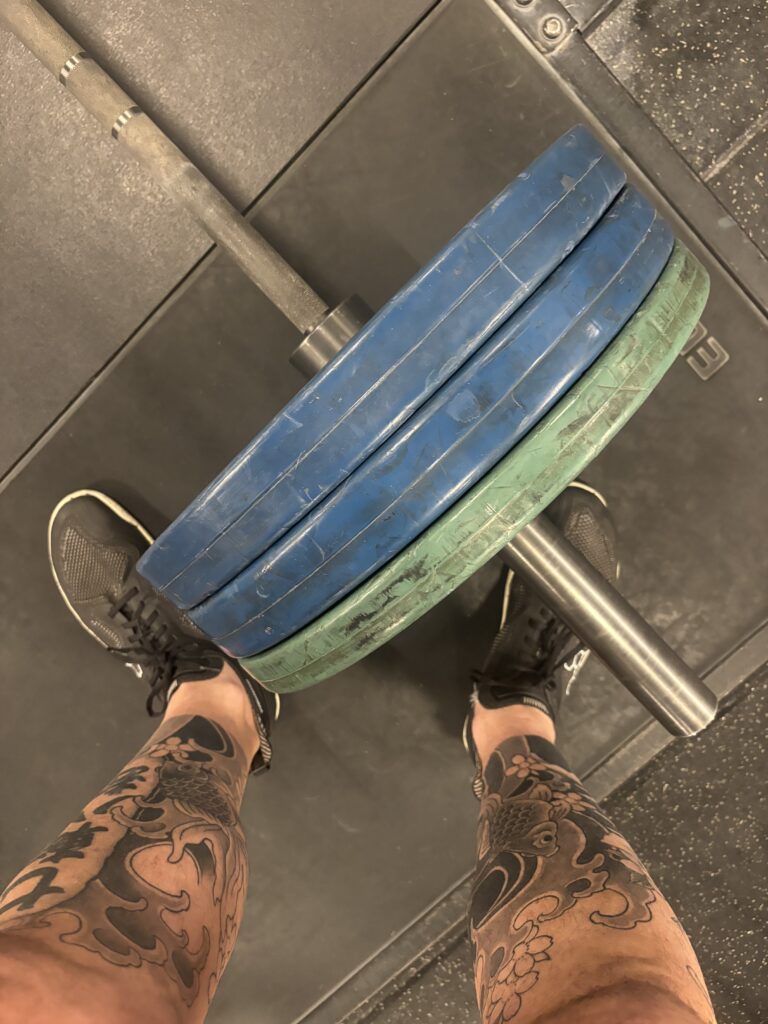
The lift I’ve chosen as my measuring stick is the deadlift. Straight Olympic bar, conventional stance, the bar pulled clean from the floor to a standing lockout. No trap bar, no straps doing the gripping for me, no machinery. Just the oldest test there is: can you pick the heavy thing up?
People ask why the deadlift and not the squat or the bench. There’s an honest version and a true version, and they’re both worth saying.
The honest version is that my body made some of the choice for me. Twenty-seven fractures in recent years, a plate holding one collarbone together, and the other sporting a hefty lump on it. A shoulder that won’t rotate far enough to even get under a squat bar. These aren’t things I dwell on, but they’re facts, and they take two of the three big lifts mostly off the table. My bench is weak and probably always will be. The squat isn’t a strength question; it’s a question of whether I can physically get into the position, and the answer is no. You work with the chassis you’ve got. You don’t make an excuse; you adapt and find a way to do something hard.
But the true version is simpler than all that, and I’d be lifting this way even with a body that had never broken: I just love the deadlift. There’s nothing between you and it. No rack, no spotter, no fussing with bar position or depth judges—the weight is on the floor and either it comes up or it doesn’t. It’s the most honest movement in the gym, maybe the most honest test there is. A bar, the ground, and the question. Everything I’ve ever found satisfying has had that shape to it. The deadlift just makes it literal. I’ve heard it called The King of Lifts, and I buy that.
What “good” actually means
I’m a numbers person. For my marathons I wanted to run the average time for my age group. I thought that was fair, given that at 194cm and 100 kg, I am hardly the archetypal small whippet of a runner.
So the first thing I wanted was an honest benchmark. Not gym-bro folklore – “a real man pulls double bodyweight” and all that – but something built on data I could interrogate. For the deadlift over 60, I wanted a real target, grounded in fact not myth.
The reference I landed on is Strength Level’s standards, drawn from over twenty-two million logged lifts. What makes them useful is that they cross two variables most charts ignore: bodyweight and age. Both matter enormously. A 125 kg pull from a twenty-five-year-old and a 125 kg pull from a man of 69 are not the same achievement.
Here’s the framework. The tiers run Beginner, Novice, Intermediate, Advanced, Elite. Advanced means you’re stronger than roughly eighty per cent of lifters; typically the product of five-plus years of consistent progression. For a man taken at face value, the Advanced barbell deadlift sits around 228 kg, which is a long way off and frankly not where I’m aiming. As an average athlete at best, I could never have lifted that at any age.
But the age curve tells the real story, and it’s worth understanding rather than hiding from. The standards taper steeply past fifty. By the mid-sixties, the Advanced threshold for a man drops to 143 kg. That’s not the chart being kind. That’s the chart being accurate about what a human body does across decades, and about how much it takes to hold ground against that decline.
Which brings me to Thursday. I pulled 125 kg. Conventional, straight bar, clean lockout. A multiple Olympic gold medallist remarked to me, “That’s a lot of tin to shift at any age.” I’ll take that from an all-time great.
So by the honest, age-adjusted reading, I’m at the higher end on Intermediate. My target for December is 135 kg. That was the target I pulled out of a hat back in January. If I get that, it puts me at the top of the Intermediate band, not the bottom of it. A year ago that sentence would have read as fantasy. Now it reads as a training block.
And if you know me well enough, you know that 135 kg is the goal. But that the number 143 kg will be in my mind. Long limbs, a long bar trajectory, and a lot of creaking mean the big number is out of reach. But it’s still a serious deadlift over 60. It’s good to dream, though. Right?
Why any of this matters
I could dress this up as health optimisation, and it is partly that. But “it’s good for you” is the kind of limp phrase that lets you skip the gym, so let me put some hard numbers on the table instead.
Start with the lift itself. Grip strength turns out to be one of the most stubbornly reliable predictors of how long you live that anyone has found. The big PURE study, tracking close to 140,000 people, found that every 5 kg drop in grip strength came with a 16% higher risk of dying from any cause and a 17% higher risk of dying from cardiovascular disease, and that grip was a better predictor of death than systolic blood pressure. Read that twice. Your handshake tells the actuaries more than your blood pressure cuff does. And the deadlift, the lift I happen to love, is essentially a grip-strength contest with your whole posterior chain attached.
Now the training. The dose-response numbers are almost comically encouraging for the lazy. A 2022 meta-analysis pooling sixteen studies found that any resistance training at all cut all-cause mortality by about 15%, cardiovascular death by 19%, and cancer death by 14%, independent of any cardio you do. The sweet spot is absurdly small: the maximum benefit, a 27% reduction in the risk of dying, lands at around 60 minutes a week. Not 60 minutes a day. An hour a week. Beyond that the curve flattens; do more if you enjoy it, but you’ve already banked most of the longevity dividend by the end of one decent session.
And the two stack. When researchers combine strength work with aerobic exercise, the effects are additive, not redundant: people doing both showed roughly a 40% lower risk of death from any cause than people doing neither. A year of running, then, wasn’t wasted base; it was the other half of the equation.
The honest caveat, because I promised data and not a sales pitch: these are observational studies, so they show association, not proof of cause, and the people who lift tend to do other sensible things too. But the signal is large, consistent across populations, and biologically plausible. The research is unambiguous on one point in particular: the steep part of the benefit curve is at the low end. Getting from can’t to can matters far more than any vanity number above it. It’s not an easy task to deadlift over 60. The 143 kg is for my ego. The first 60 minutes a week is for my life.
Feeding the machine
You can’t out-train a bare cupboard, and this is the part that doesn’t surprise me. I was almost obsessive about my in-run fuelling, and made sure I recovered well. But the short, sharp, intense loads of the deadlift over 60 damage a lot of muscle fibres. Recovery is still the key, and although I don’t need to carry gels with me everywhere, protein is a huge consideration.
The science on protein and ageing muscle is clear and slightly uncomfortable: older bodies are worse at turning protein into muscle than young ones — “anabolic resistance,” they call it — so we need more of the stuff, not less, exactly when most people start eating less of it. The consensus for an older adult who lifts sits around 1.2 to 1.6 g per kg of bodyweight per day, well above the official RDA that was set merely to prevent deficiency rather than to build anything.
For me at 100 kg, the top of that range is about 160 g a day. I’m currently landing around 175 g, which I’ll admit took real effort to reach and to count. Distribution matters as much as the total: the research points to 20–40 g of protein per meal, spread across the day, because older muscle needs a bigger per-meal hit than young muscle to switch protein synthesis on at all. One giant steak at dinner doesn’t do it; four solid feedings do. You can bet there are some impressively large bags of whey protein in my cupboard. (And a fine white powder scattered on the worktop, all too often.) I seek out any opportunity to ingest a few grams of protein throughout the day, even when I’m out and about.
Around that foundation I run a deliberately short supplement stack, and I’m sceptical of anything longer. Vitamin D with K2 through the dark British winter, magnesium, omega-3, B12, and collagen. I won’t oversell these. The honest position is that protein and the training are the engine, and the supplements are, at best, the oil. Vitamin D and omega-3 have reasonable evidence behind them for people my age; collagen is more speculative, though the connective tissue argument is plausible enough that I’ll keep taking it while my tendons learn to love heavy weight again. None of it substitutes for the 175 g and the bar on the floor. It just keeps the edges from fraying.
The point of all of it — the protein, supplements, the hour a week — is the same. I’m not optimising a spreadsheet. I’m trying to arrive at eighty still able to pick heavy things up off the floor.
Who I’m doing this for
But the numbers aren’t really why I’m doing it. I’m doing it because I’ve reorganised the next twenty years around who I want to be rather than what I’ve already achieved, and one of those identities is someone who is strong. Not strong for his age, with the apology built into the phrase. Just strong, with the age noted as context. Deadlift at 60? No; deadlift, any age.
Sixteen months and 1,800kms of training taught me I can suffer for hours. Now I want to find out what I can do in seconds. The bar’s on the floor. December’s coming.
Let’s go.