1973 and 1989 Encounters
The last time I saw Robert Plant perform live was 53 years ago, at Preston Guildhall in January 1973. That set changed my life.
I was 15, from a small town in rural Lancashire. I scraped together my money for vinyl and read the NME from cover to cover every week. And there they were: Plant, Page, Bonham and Jones, smashing out their classics. Two encores. Local councillors were up in arms because Zeppelin’s sound system ran at 4,500 watts against the house system’s meagre 60. Later the council banned David Bowie, Led Zeppelin and Roxy Music altogether, for being a bad influence on local youth. Seriously.
Sixteen years on, on 13 May 1989, I was in the players’ tunnel at Preston North End’s Deepdale ground, leaning on the wall and watching my American football team warm down on the plastic pitch. The mighty North End, then in the Third Division, were about to take on Wolverhampton Wanderers. It finished 3–3.
I was half aware of someone settling against the wall beside me. I glanced to my right. Robert Plant. The man I’d watched at the Guildhall, hair and all, leaned against the white-painted brickwork in a red plaid lumberjack shirt, hands shoved into his jeans pockets.
He smiled, nodded towards the players and said, “Yankee football, eh?”
That was it. No entourage, no performance, just a Wolves fan on an away day, amused by the sight of shoulder pads in Preston. I explained what we were doing there, and for a few minutes we talked sport like two blokes at a match, which is exactly what we were.
San Francisco Orpheum Theatre
Now it’s 2026, and I’m in San Francisco, at the Orpheum Theatre, waiting for him to walk on stage with Saving Grace. He’s 78. I’m 69. Neither of us is the person we were at the Guildhall, and I can’t wait to hear who he is now.
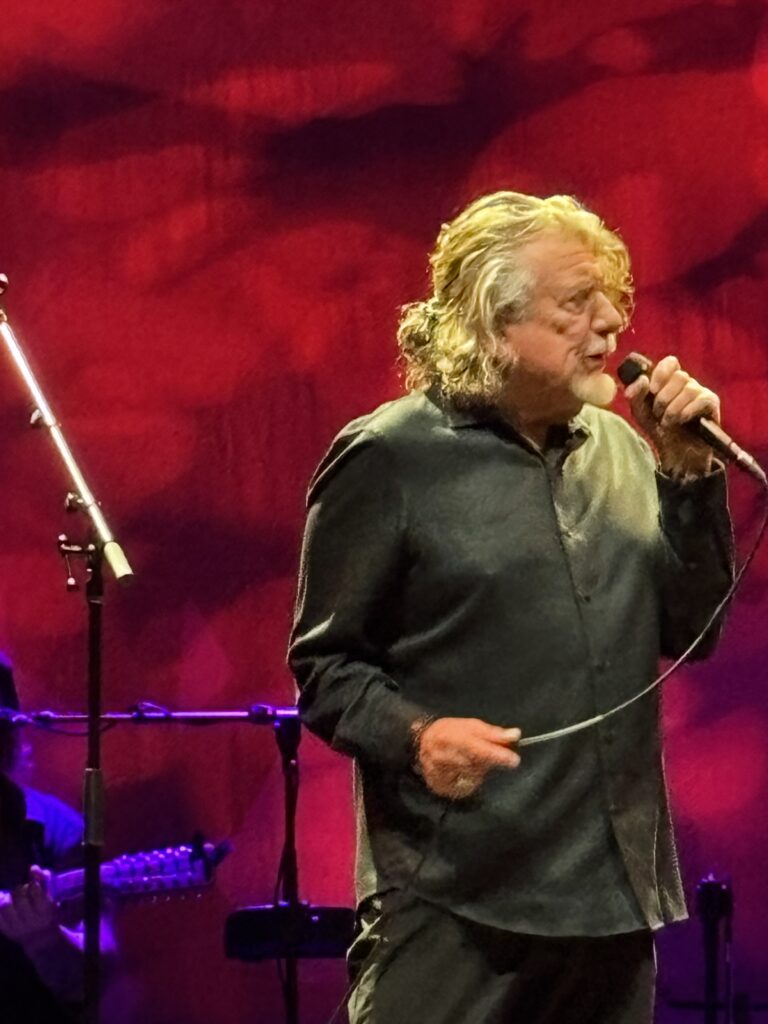
I’ll confess something: I hadn’t listened to Saving Grace before last night. Might have seen one track on a BBC Music programme. I went for Plant. I came away a fan of the band. Plant had begun collborating with them in the COVID era, playing folk and blues music. They released an album last year.
They opened with The Very Day I’m Gone, a traditional song, and that set the tone for the night. This is a band rooted in old music: folk, gospel, Appalachian ballads, songs older than anyone in the room, played as though they were written yesterday. The Cuckoo followed, another traditional tune with centuries behind it, and by then I could hear how tight and deeply melodic they are, every one of them a first-rate musician. Tony Kelsey is superb on guitars and banjo. Matt Worley plays strings and has a powerful voice of his own. And I’d never realised how hard a cello can rock.
Then, second song in, came Ramble On. The Orpheum was in the palm of his hand. All around me, people were quietly singing along, almost under their breath, as if afraid to break the spell. A song I first heard on vinyl as a teenager in Lancashire, sung by the man himself, half a century on.
Suzi Dian is a superb foil for Plant. On the Irish ballad As I Roved Out and on Gillian Welch’s Orphan Girl, her voice rang bell-clear, and he wove his around it, then gracefully stepped back to let her carry the song. It’s a generous thing to watch. A man who once fronted the biggest band in the world, content to share the light.
But it’s hard to take your eyes off him. He dominates the stage without ever seeming to mean to. He moves like a 78-year-old man, and then suddenly he prowls like the old rock god. Without thinking, he holds the mic and the cable exactly as he did fifty years ago. Muscle memory from another age.
The voice hasn’t weakened, not in any way that matters. He’s too much of a pro to force the high notes. He caresses them instead, and they hit harder for it. Lower down, he’s richer than he ever was, and decades on stage have given him superb timing. You hear it best on the gospel material. On There Ain’t No Grave Gonna Hold My Body Down, an old song by the preacher Brother Claude Ely, he sounded like a man who’d earned every word.
The Zeppelin songs were placed with care. Besides Ramble On, there was Four Sticks, named for John Bonham’s habit of playing it with two sticks in each hand, and Friends, from the third album. He’s wise enough not to turn the night into Led Zeppelin karaoke. He sprinkles in just enough to anchor the evening, and the effect is massive. Between them came two of his own songs from Fate of Nations, Calling to You and Down to the Sea, and a Neil Young cover, For the Turnstiles. He paid fond tribute to Young.
The staging suited the Orpheum’s ornate architecture: a huge bison at the centre, with psychedelic patterns washing over it and replacing it as the night went on.
He worked the crowd like an old-school entertainer. As people began rising to their feet, he teased them: “Stand up. No, you can’t sit down.” He remembered playing San Francisco in 1969, when the crowd wanted to stand but mostly couldn’t and lay on the floor instead. A sly nod to what the city was consuming in those days. He chatted with the first few rows (I was in row five), traded jokes with the shouters in the crowd, and called out “Come on down!” two or three times, like a host on British Saturday-night TV.
They closed the main set with Babe I’m Gonna Leave You, the Anne Bredon song Zeppelin recorded on their debut album in 1969. Partway through, I realised I was awash with emotion, eyes damp and chest full. The years were rolling back to the Guildhall, to a 15-year-old who’d scraped together his money for a ticket and had no idea what was about to hit him.
For the encore, he paid tribute to the city with It’s a Beautiful Day Today by Moby Grape, a San Francisco band from the city’s psychedelic heyday, followed by Low’s Everybody’s Song. Then the band huddled together and sang And We Bid You Goodnight a cappella, an old traditional song that the Grateful Dead often used to close their shows in this city. It was a perfect farewell. Voices only, no instruments, no amplification, nothing between the song and the room, the band within touching distance of the audience.
I left emotional and grateful. Grateful to have seen this reinvented rock god, a man who, after Zeppelin, went exploring through blues, folk, Americana and the desert blues of Tinariwen, my favourite band of that kind. He’s never stopped being curious. Fifty-three years after the Guildhall and thirty-seven after a few minutes in a tunnel at Deepdale, he’s still searching for the next song.
It caps a remarkable ten days: Marcus Miller, Ron Carter, Herbie Hancock and Robert Plant. A feast of legends.
Thanks for sharing.
Wonderful
Thank you
I was at the concert and your write up about it is absolutely perfect! I’ve been lucky enough to have seen him twice before once with the Band of Joy and once with Alison Kraus, he is always amazing. I think he gets better with age!
Thank you! What a night. One for the ages.